
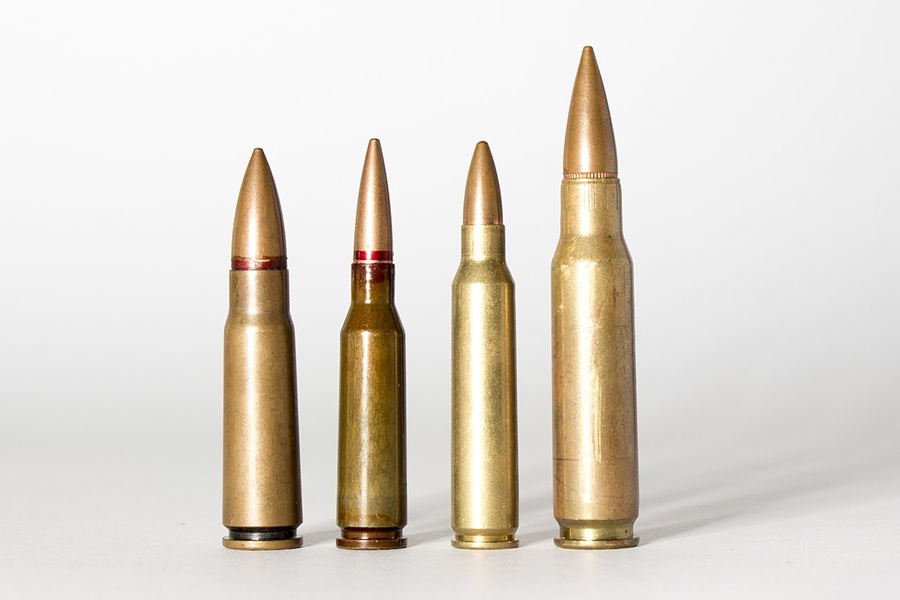
7.62x51mm NATO
The 7.62x51mm NATO round is a full-power rifle cartridge that has been widely used by militaries and marksmen around the world. Known for its impressive power, reliability, and versatility, this cartridge is often associated with larger, more robust rifles designed for long-range accuracy and greater stopping power. Let’s explore the key features of the 7.62x51mm NATO round and why it remains a prominent choice in modern firearm discussions.
Key Characteristics
- Dimensions: The 7.62x51mm NATO cartridge measures approximately 51mm in case length, making it a larger round compared to intermediate cartridges like the 5.56x45mm NATO.
- Bullet Weight: Typically ranges from 147 grains to over 175 grains depending on the application, offering significant mass for energy delivery.
- Energy: Produces higher muzzle energy, often exceeding 2,400 foot-pounds (ft-lbs), translating into enhanced kinetic force upon impact.
- Effective Range: Capable of maintaining accuracy at distances beyond 800 meters when paired with precision rifles.
Advantages of the 7.62x51mm
- Stopping Power
The heavier bullet weight ensures superior stopping power against hardened targets or in situations where penetration is crucial. - Long-Range Effectiveness
Ideal for sharpshooting or sniping roles, this round maintains better stability and energy retention over long distances compared to smaller calibers. - Versatility in Platforms
Widely used in designated marksman rifles (DMRs), sniper systems (e.g., M24 or SR-25), as well as light machine guns like the M240. - Performance Against Barriers
The round excels at penetrating obstacles such as walls or dense vegetation without significant deflection or loss of momentum.
Limitations
- Recoil: Heavier recoil makes sustained fire more difficult, especially from lighter platforms.
- Weight: Both the ammunition itself and rifles chambered for it tend to be heavier compared to alternatives like the 5.56x45mm NATO.
- Capacity Reduction: Magazines hold fewer rounds due to increased cartridge size—commonly around 20 rounds per magazine versus up to 30+ with smaller calibers.
| Feature | Pros | Cons |
| Power | High stopping power; effective at range | Increased recoil |
| Range | Superior at long distances | Requires more marksmanship skill |
| Ammunition Weight | Reliable penetration | Heavier load limits mobility |
| Weapon Compatibility | Effective with precision weapons | Limits magazine capacity |
Applications in Modern Use
The military often reserves this caliber for specialized roles where its advantages outweigh its drawbacks: – Sniper teams needing precise hits at extreme distances. – Machine gunners provide suppressive fire where penetration is critical. – Hunters targeting medium-to-large game due to ethical stopping power.
In civilian markets, shooters appreciate the round’s accuracy potential for competitive shooting disciplines or hunting scenarios requiring longer shots across open terrain.
By understanding these attributes of the 7.62x51mm NATO round, you can better evaluate whether its strengths align with your intended application or if another caliber may serve your needs more effectively without added trade-offs such as weight and recoil dynamics.
5.56x45mm NATO
The 5.56x45mm NATO cartridge, a staple of modern military and civilian shooting alike, has become synonymous with lightweight versatility and adaptability. This cartridge is widely used in AR-style rifles and other platforms due to its combination of manageable recoil, respectable ballistics, and logistical efficiency. Below, we’ll dissect the key characteristics that define the 5.56 NATO and explore why it’s such a popular choice across multiple applications.
Origins and Design
- Introduced: The 5.56x45mm NATO was developed in the late 1950s for use in the M16 rifle, replacing older calibers like the .30-06 Springfield and 7.62x51mm as standard issue for many western militaries.
- Design Goal: The focus was on creating a smaller, lighter round that produced less recoil while maintaining sufficient effectiveness at moderate ranges.
- Bullet Weight: Typically ranges between 55 grains (M193) to 77 grains (Mk262).
- Case Length: Measures 45mm long, making it significantly smaller and lighter than more powerful rounds like the 7.62x51mm.
Key Advantages
- Lightweight Ammunition: Soldiers can carry more rounds compared to heavier cartridges like the 7.62 NATO.
- Example: A soldier can carry approximately two to three times as many rounds of 5.56 compared to an equivalent weight in 7.62 ammunition.
- Reduced Recoil:
- Makes rapid follow-up shots easier during semi-auto or fully automatic firing modes.
- Beneficial for new shooters or those who value control over raw power.
- Flat Trajectory at Medium Range:
- Effective range is typically up to 300–500 meters depending on barrel length and bullet type.
- This flat trajectory simplifies aiming, especially with modern optics.
| Feature | Benefit |
| Lightweight design | Easier to transport; higher ammo capacity |
| Reduced recoil | Faster follow-up shots; better control |
| Flat trajectory | Simplifies aiming within effective range |
Applications
- Standard issue for many armed forces worldwide due to its balance between performance and logistics.
- Particularly effective in close-to-medium-range firefights.
- Popular among civilian shooters for target practice or competition shooting due to its affordability and availability.
- Adequate for hunting small game or varmints such as coyotes but less ideal for larger targets.
- Offers sufficient stopping power without excessive penetration (depending on projectile type), reducing risks in urban environments.
Limitations
- Energy levels drop off significantly past 500 meters compared to larger calibers like the 7.62 NATO.
- Wind drift affects lighter bullets more at extended ranges.
- Struggles against hardened barriers such as concrete or thick cover compared to heavier rounds.
By understanding these strengths and limitations, users can better align their expectations with what this cartridge offers in real-world scenarios—whether on-duty, hunting in open fields, or honing skills at the range.
The Size Difference
When discussing the differences between the 7.62x51mm NATO and 5.56x45mm NATO rounds, size is one of the most obvious distinctions. These cartridges were designed for different purposes, and their dimensions reflect those differences. Understanding their physical characteristics gives a better sense of how they perform in various scenarios.
Cartridge Dimensions
| Feature | 7.62x51mm NATO | 5.56x45mm NATO |
| Overall Length | 71.12 mm (2.8 in) | 57.4 mm (2.26 in) |
| Bullet Diameter | 7.82 mm (0.308 in) | 5.7 mm (0.224 in) |
| Case Length | 51 mm | 45 mm |
| Weight per Round | ~25 grams | ~12 grams |
The larger case of the 7.62 round allows for more propellant, which generally translates to greater power and range compared to the smaller, lighter 5.56 round.
Impact on Design and Carrying Capacity
The size difference doesn’t just affect ballistic performance—it also has practical implications for firearm design and ammunition carrying capacity.
- Weapon Design: Rifles chambered for the larger, heavier 7.62 round are bulkier to accommodate its size and power, often resulting in heavier barrels and reinforced actions.
- Ammunition Weight: Soldiers can carry significantly more rounds of lighter-weight 5.56 ammunition compared to the heavier 7.62 rounds:
- Approximate weight of 100 rounds:
- 1.1 NATO: ~1,200 grams (~2.6 lbs)
- 2.2 NATO: ~2,500 grams (~5.5 lbs)
- Approximate weight of 100 rounds:
This weight disparity means that troops equipped with rifles chambered for the smaller cartridge can carry more ammunition into combat or training scenarios without being as burdened by excess weight.
Magazines and Round Count
- Standard magazine capacities for assault rifles:
- AR-15/M4 (5.56): Typically holds up to 30 rounds.
- AR-10/FN SCAR-H (7.62): Typically holds up to 20 rounds.
- Troops armed with a rifle chambered in 7.62 NATO often sacrifice magazine capacity due to its increased physical dimensions.
Practical Implications
- The compact nature of a typical rifle chambered in 5.56 makes it ideal for close-quarters combat or engagements requiring fast movement.
- Rifles chambered in 7.62, conversely, are better suited for situations where long-range accuracy or stopping power is essential but come with added weight penalties.
By understanding these contrasts, shooters can make more informed decisions about which caliber better meets their specific needs based on mission requirements or personal preferences without overlooking practical tradeoffs like portability or weapon ergonomics.
Where the 5.56 Dominates
The 5.56x45mm NATO round has become one of the most widely used rifle cartridges for military, law enforcement, and civilian applications worldwide. Its smaller size, lighter weight, and specific performance characteristics give it several clear advantages in certain scenarios. Let’s explore the key areas where the 5.56 shines.
Lightweight and Portability
One of the primary advantages of the 5.56 round is its compact size and reduced weight compared to larger-caliber rounds like the 7.62x51mm NATO. This difference offers numerous benefits: – Increased ammo capacity: Soldiers can carry significantly more 5.56 ammunition without being weighed down. – Improved maneuverability: The lighter weight of both the ammunition and rifles chambered for 5.56 results in greater ease of movement, especially in dynamic combat environments. – Example: An infantry soldier might carry up to three times more 5.56 rounds than they could with 7.62 rounds for the same overall load.
Reduced Recoil
The smaller size and lighter bullet of the 5.56 generate considerably less recoil compared to its larger counterpart: – Ideal for rapid follow-up shots or bursts during close-quarter engagements. – Easier for newer shooters or small-statured individuals to handle effectively. – Better accuracy under sustained fire due to less muzzle rise after each shot.
Superior Performance at Shorter Ranges
While not designed for long-range precision, the 5.56 excels at distances typically encountered in urban warfare or close-quarter combat (CQC): – Effective range: Optimal performance within approximately 300–500 meters. – Wound ballistics: At close ranges, higher velocities allow the bullet to fragment upon impact, creating significant tissue damage.
Adaptability with Modern Platforms
The versatility of rifles chambered in 5.56 enhances its dominance: – Modularity: Many modern platforms (e.g., AR-15 variants) allow users to configure their rifles with attachments like optics, foregrips, or suppressors tailored to specific missions. – Widely distributed standardization: As a NATO-designated cartridge, parts and ammunition are readily available globally.
| Key Feature | Benefits |
| Weight | Allows carrying more ammo; better mobility |
| Recoil | Enhanced control; quicker follow-up shots |
| Effective Range | Optimized for engagements under ~500 meters |
| Rifle Compatibility | Works seamlessly with modular platforms common in military inventories |
Cost Efficiency
For military forces or recreational shooters on a budget: – The mass production of 5.56 rounds keeps costs lower than many other calibers. – Training exercises can be conducted more affordably due to cheaper ammunition.
These distinct advantages make the 5.56 a top choice for applications where mobility, ease of use, and short-range effectiveness are paramount—factors that have cemented its place as a preferred cartridge both on and off the battlefield.
Where the 5.56 Dominates
Lightweight Design and High Capacity
One of the most notable advantages of the 5.56 round is its smaller size and lighter weight compared to the 7.62x51mm NATO round. This has significant implications:
– Increased Magazine Capacity: Most standard magazines for rifles chambered in 5.56 can carry up to 30 rounds, whereas magazines for rifles chambered in 7.62 tend to hold fewer rounds (often between 20-25).
– Less Fatigue During Extended Use: Soldiers or enthusiasts carrying multiple magazines will find that the overall weight load is significantly reduced when using 5.56 ammunition. This allows for longer periods of maneuverability without excessive strain.
| Feature | 5.56x45mm NATO | 7.62x51mm NATO |
| Magazine Capacity | Typically ~30 rounds | Typically ~20-25 rounds |
| Weight per Cartridge | ~12 grams | ~24 grams |
Superior Velocity and Flat Trajectory
The smaller size and lower mass of the 5.56 bullet allow it to achieve impressive muzzle velocities (approximately 3,000 feet per second or more). This translates into several practical advantages:
– Flat Trajectory: The high velocity ensures that bullets travel along a flatter trajectory over long distances, improving accuracy at medium ranges (up to approximately 500 yards).
– Reduced Bullet Drop: Shooters need less adjustment for elevation when engaging targets at varying distances compared to heavier, slower-moving rounds like the 7.62.
Reduced Recoil
Another area where the 5.56 dominates is its low recoil impulse:
– Faster Follow-Up Shots: Low recoil makes it easier to stay on target during rapid-fire situations or when engaging multiple targets in quick succession. – Reduced Training Burden: For new shooters or those less experienced with firearms, the manageable recoil makes learning marksmanship skills less intimidating compared to higher-recoil calibers.
Ideal for Urban or Close Quarters Combat
The compact nature of rifles chambered in this caliber complements its performance in tight spaces:
– Quick Target Acquisition: Lighter weapons paired with lighter ammunition enhance maneuverability within confined environments such as buildings or urban areas. – Reduced Overpenetration Risk: The smaller bullet profile often results in lower levels of penetration through walls or barriers compared to larger rounds like the 7.62.
Cost Efficiency
From both a logistical and financial perspective:
– Cheaper Ammunition Production: The materials required to produce a single round of 5.56 are generally more economical than those needed for larger-caliber cartridges. – Increased Availability: Due to widespread adoption by militaries and civilians alike, finding affordable surplus or bulk packs is relatively easy.
Overall, while the effectiveness of any caliber depends greatly on its intended application, these strengths highlight why many modern militaries rely heavily on rifles chambered in this efficient round for standard operations—particularly when speed, capacity, and mobility outweigh raw stopping power considerations provided by larger calibers like the 7.62x51mm NATO round.
Where the 7.62x51mm Rules
The 7.62x51mm NATO round stands out in specific scenarios where power, penetration, and longer effective range are critical. This section examines the key areas where this round exhibits significant advantages over its smaller counterpart, the 5.56x45mm NATO.
Superior Stopping Power and Penetration
- Barrier penetration: The 7.62x51mm can penetrate tougher materials like walls, light vehicles, or body armor more effectively than the 5.56x45mm.
- Thicker hides in game hunting: When used for hunting larger animals (e.g., deer or hogs), this round ensures a cleaner and more ethical kill due to deeper wound channels.
This ability to maintain energy at longer distances is critical in combat situations where targets may be partially obscured by cover or located beyond the reliable range of a smaller caliber.
Effectiveness at Longer Ranges
Another area where the 7.62 excels is long-range engagements. Its ballistic performance makes it ideal for precision shooting over extended distances:
– Effective range: While the 5.56 NATO typically has an effective range up to approximately 500 meters for standard rifles, the 7.62 can reach out to roughly 800 meters with accuracy. – Energy retention: The heavier projectile of the 7.62 retains more kinetic energy at farther ranges, ensuring lethality even at distances where lighter rounds may lose effectiveness.
This makes it a preferred choice for designated marksmen and sniper applications in military contexts.
Reliability in Adverse Conditions
The robust nature of rifles chambered in 7.62 also gives them an edge in challenging environments:
– Wind resistance: The heavier bullet is less affected by wind drift compared to smaller calibers like the 5.56. – Performance through barriers: In scenarios involving dense vegetation or obstacles like glass windows, the round maintains better trajectory integrity.
For military units operating in mountainous terrain or areas with adverse weather conditions, these factors can be game-changing operational advantages.
Tactical Scenarios Favoring the Round
Certain tactical situations call specifically for rifles chambered in this caliber:
– Urban warfare: When breaking through walls or other hard surfaces is necessary. – Vehicle interdiction: Disabling vehicles often requires larger-caliber rounds capable of breaching robust engine components. – Anti-material roles: While not as powerful as dedicated anti-material rounds such as .50 BMG, some marksmen utilize heavy-grain options within this caliber for intermediate anti-material tasks.
| Feature | Advantage with 7.62x51mm |
| Effective Range | Longer (up to ~800m) |
| Barrier Penetration | Superior |
| Kinetic Energy Retention | Greater at all ranges |
| Wind Resistance | Improved |
Strategic Use Cases
While not suitable for every mission type due to its increased weight and recoil (discussed elsewhere), forces requiring durability and power find undeniable utility in this round during missions involving armored adversaries or extended engagements beyond typical infantry ranges.
By excelling in these distinct roles, particularly those demanding power over portability, the versatility of the 7.62x51mm NATO continues to make it an invaluable tool on modern battlefields and among civilian enthusiasts alike—especially hunters and long-range precision shooters seeking dependability under varying conditions without compromise on capability.

Andro Corp Industries 55616BB ACI-15 Bravo 5.56 NATO 30+1 16″
Andro Corp Industries 55616BB ACI-15 Bravo 5.56 NATO 30+1 16" Black Nitride Threaded Barrel, Black Anodized…
SPRINGFIELD ECHELON ALPHA 9MM – 4″ 15RD BLACK COMPACT FRAME
SPRINGFIELD ECHELON ALPHA 9MM - 4" 15RD BLACK COMPACT FRAME