
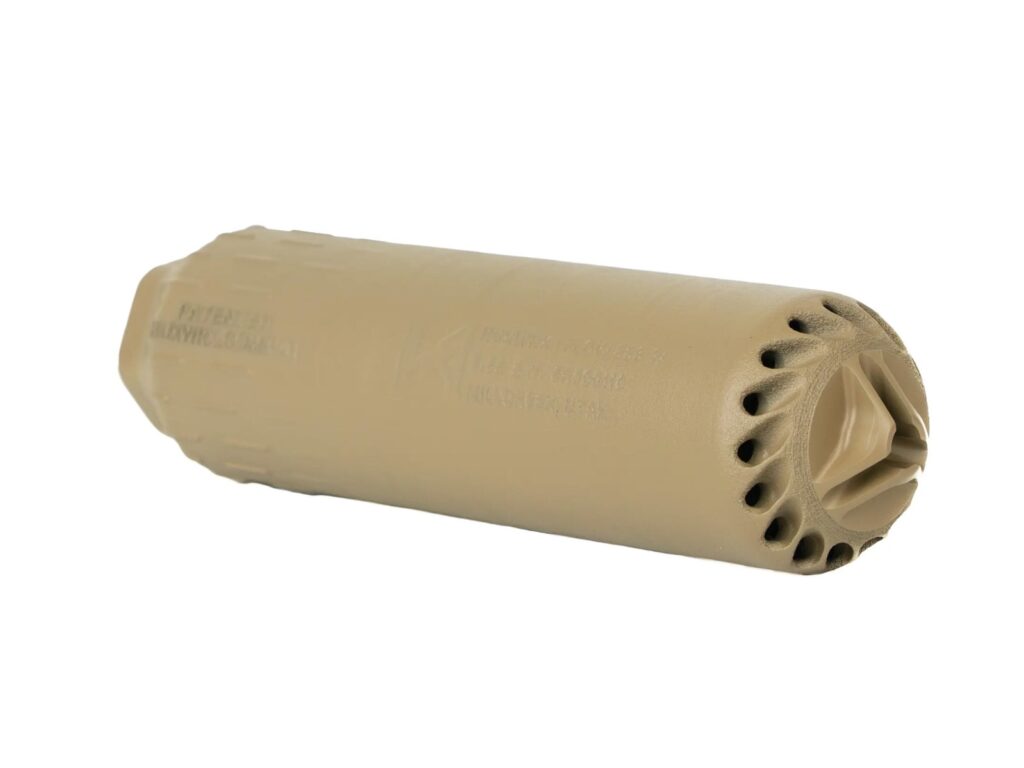
If you have ever run a suppressed AR-15 hard, you know the trade-off. Traditional baffle suppressors trap gas and push it back through the chamber, into the receiver, and straight into your eyes and lungs. You get sound reduction, but you pay for it with a face full of gas, accelerated fouling, and a rifle that suddenly needs an adjustable gas block, a heavier buffer, and a different bolt carrier to run right. The huxwrx flow ti changes that equation completely. This is a suppressor built from the ground up to eliminate gas blowback without asking you to re-engineer your rifle. In this review, we break down the specs, sound performance, gas system impact, mounting system, durability, and real-world user feedback to help you decide if the Flow 556 Ti belongs on your rifle in 2026.
What Is the HUXWRX Flow 556 Ti? — Specs and Design Philosophy
The HUXWRX Flow 556 Ti is a dedicated 5.56 suppressor manufactured entirely from Grade 5 Titanium using Direct Metal Laser Sintering (DMLS), a 3D-printing process that builds the suppressor layer by layer from powdered metal. The result is a monolithic structure with no welds, no seams, and no joints that can fail under heat and pressure. The exterior gets a C-series high-temperature Cerakote finish, available in Black or Flat Dark Earth, which holds up to the kind of heat generated during sustained fire schedules.
On the scale, the Flow 556 Ti weighs 11.4 ounces (323 grams). It measures 6.8 inches in length and 1.8 inches in diameter. Those numbers put it squarely in the full-size 5.56 suppressor category, but at the lighter end of the weight spectrum thanks to the titanium construction. For context, many steel-bodied 5.56 cans push past 16 ounces, so shaving nearly a third of a pound off the muzzle matters for rifle balance, especially on longer guns or rifles you carry all day.
The caliber rating spans from .22 LR up through 5.56 NATO, and HUXWRX imposes no barrel length restrictions. The suppressor is full-auto rated and has passed the USSOCOM Reliability Stress Test, a battery of evaluations that simulates hard military use including high round counts, rapid fire schedules, and extreme temperature exposure. The MSRP for the kit, which includes the suppressor and one Flash Hider QD 556 with 1/2×28 threads, sits at $1,624. Street pricing through dealers like SilencerShop runs lower, often between $1,299 and $1,400, which makes the real-world cost more competitive than the sticker price suggests.
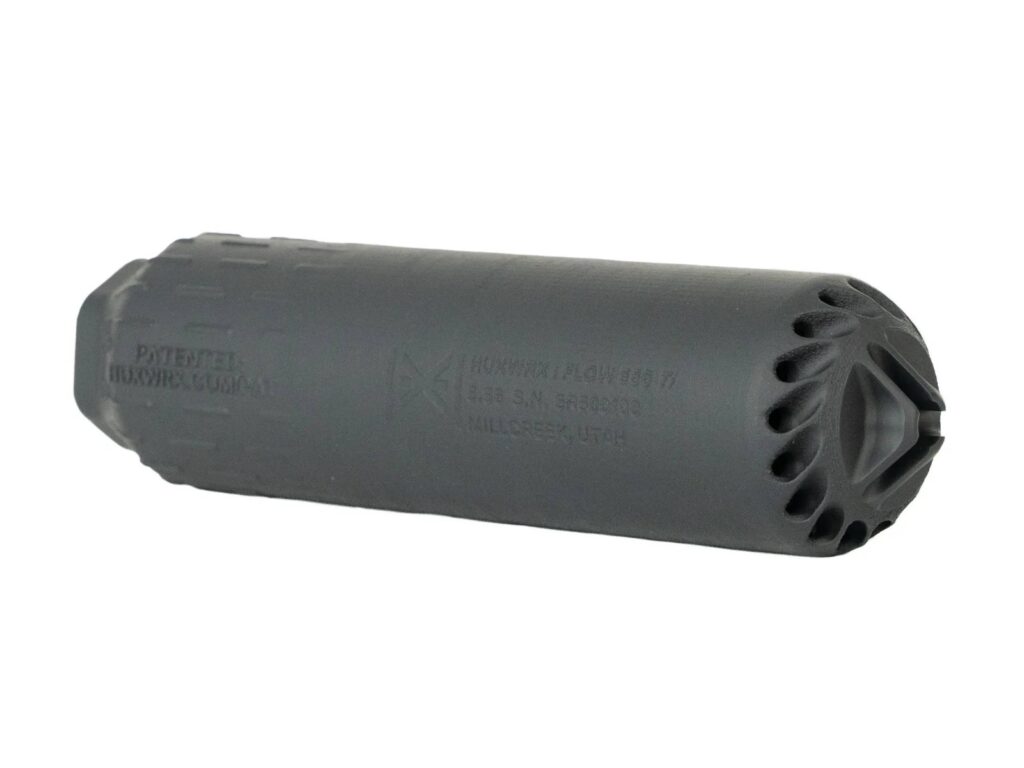
HUXWRX markets the Flow 556 Ti under the tagline “Compromise Elsewhere.” The idea is that you should not have to choose between sound suppression, weight, durability, and gas management. The Flow 556 Ti aims to deliver all four without forcing the shooter to accept a meaningful downside in any category.
Flow-Through Technology Explained
The defining feature of the Flow 556 Ti is its patented flow-through gas path. In a traditional baffle suppressor, expanding propellant gases hit a series of internal baffles that slow and cool the gas before it exits the muzzle. That process works for sound reduction, but it also creates backpressure. Gas that cannot escape forward fast enough gets pushed backward through the barrel and into the receiver. The result is increased bolt carrier velocity, more fouling in the action, and a plume of gas venting from the charging handle area directly into the shooter’s face.
HUXWRX redesigned the internal geometry so that gas flows forward through the suppressor rather than stacking up against baffles. The flow path directs combustion gases out the front of the can while still providing expansion volume and surface area for sound reduction. The company claims that bolt velocity increases by less than 5% compared to an unsuppressed baseline. In practical terms, that means the rifle cycles at nearly the same speed with the suppressor attached as it does without it.
This design eliminates the primary complaint shooters have about suppressed AR-15s: gas to the face. Reddit users on r/NFA consistently report that the Flow 556 Ti produces “no gas going backwards and a very pleasant tone.” For anyone who has spent a training day blinking through stinging eyes while their rifle chokes on its own fouling, that claim carries weight. The flow-through system also means you do not need an adjustable gas block, a heavier buffer, or a gas-busting charging handle. The rifle runs as configured from the factory.
Sound Performance — Is the Flow 556 Ti Hearing Safe?
HUXWRX guarantees that the Flow 556 Ti will not exceed a 140-decibel ten-shot average at the shooter’s ear during the barrel’s service life. That number matters because 140 dB is the threshold commonly cited for impulse noise hearing damage. Staying below that line, especially on an averaged basis, puts the suppressor in the “hearing safe” conversation for 5.56, a cartridge that is notoriously difficult to suppress due to its high velocity and aggressive muzzle report.
The company markets the Flow 556 Ti as the quietest full-size 5.56 dedicated suppressor in the HUXWRX lineup. However, the scraped manufacturer and dealer content does not provide a specific decibel measurement at the muzzle or at the shooter’s ear on a named host weapon. This is a gap in the available data, and buyers who want a hard number to compare against competing suppressors will notice its absence. PEW Science, an independent laboratory that conducts standardized suppressor testing, has published detailed data on the larger FLOW 762 Ti, calling it “one of the most advanced systems evaluated” and noting “competitive performance across host types.” That endorsement lends credibility to the flow-through approach, but direct PEW Science data for the Flow 556 Ti has not yet appeared in the public domain as of early 2026.
What does exist is user-reported experience. Across forums and reviews, shooters describe the Flow 556 Ti’s tone as “pleasant” and note that the perceived loudness at the shooter’s ear feels lower than expected for a 5.56 suppressor. Part of that perception likely comes from the absence of gas blowback. When you are not getting blasted in the face with every shot, the overall shooting experience feels quieter and more comfortable, even if the absolute decibel level at the muzzle is comparable to other suppressors in its class. The integrated GeoFlash Cap also contributes by reducing muzzle flash, which can influence how shooters perceive noise, especially in low-light conditions.
Gas System Impact — No Tuning Required
The Flow 556 Ti’s core value proposition is simple: attach it and shoot. There is no need to swap buffers, install an adjustable gas block, or change bolt carrier groups. For shooters who own multiple AR-15s or who move a single suppressor between hosts, this plug-and-play compatibility eliminates a significant headache.
Traditional baffle suppressors increase backpressure enough that many rifles will not cycle reliably without tuning. An overgassed rifle runs the bolt carrier too fast, causing ejection pattern shifts, increased recoil impulse, accelerated parts wear, and failures to feed or extract. The standard fix involves adjustable gas blocks, which add cost and complexity, or buffer weight changes, which require experimentation and spare parts. Some shooters accept the overgassed condition and deal with the gas blowback, but that is a miserable way to train.
HUXWRX claims bolt velocity impact of less than 5% over the unsuppressed baseline. That figure means the rifle’s operating rhythm stays essentially unchanged. The bolt carrier moves at a speed the rifle was designed to handle, the ejection pattern remains consistent, and the shooter does not breathe propellant gases. This characteristic makes the Flow 556 Ti especially attractive for short-barreled rifles and full-auto hosts, where gas system timing is already more sensitive. The suppressor carries no barrel length restrictions, so you can run it on a 10.3-inch MK18 clone or an 11.5-inch pistol build without worrying about beating the rifle to death or choking on gas.
Mounting System — Torque Lock QD and GeoFlash Cap
The Flow 556 Ti uses HUXWRX’s patented Torque Lock QD mounting system, which features a left-hand thread design. This is a deliberate engineering choice that sets it apart from the right-hand threads found on most suppressor mounts. Under fire, the rotational forces generated by bullet passage and gas flow tend to tighten a left-hand threaded mount rather than loosen it. The result is a suppressor that stays securely attached during extended strings of fire without the need for secondary locking collars or ratcheting mechanisms.
The suppressor is compatible with two muzzle devices: the Flash Hider-QD 556 and the Muzzle Brake-QD 556, both in 1/2×28 thread pitch. The included kit ships with the flash hider, which provides solid flash reduction when shooting unsuppressed and serves as the mounting interface when the suppressor is attached. The muzzle brake option offers recoil mitigation for shooters who want a compensator effect during unsuppressed fire, though the suppressor itself tames recoil and muzzle rise effectively once mounted.
At the front of the suppressor, the integrated GeoFlash Cap uses a geometric flash mitigation design rather than traditional pronged flash hider tines. The geometry is built into the end cap itself, reducing flash signature without adding length or creating snag points. HUXWRX has not published quantitative flash reduction data, such as candela or millilux measurements, so buyers evaluating the suppressor for night vision use or low-light shooting will have to rely on user reports and video footage rather than hard numbers. The available anecdotal evidence suggests effective flash reduction, but the lack of quantified data is a gap worth noting.
Durability, Maintenance, and Warranty
Grade 5 Titanium, also known as Ti-6Al-4V, offers an exceptional strength-to-weight ratio and excellent heat resistance. Combined with the DMLS manufacturing process, which eliminates weld failure points, the Flow 556 Ti is built to handle hard use. The full-auto rating and USSOCOM Reliability Stress Test pass provide third-party validation of the design’s structural integrity.
HUXWRX designed the Flow 556 Ti to be serviceable. The company recommends cleaning every 2,500 to 3,000 rounds, which is a realistic maintenance interval for a centerfire rifle suppressor that sees regular use. There is a 200-round break-in period during which the suppressor’s internal geometry stabilizes and sound performance reaches its optimal level. This is not unusual for 3D-printed suppressors, where the internal surfaces benefit from a light carbon layer to smooth gas flow.
The warranty is a limited lifetime guarantee against manufacturing defects. That covers flaws in materials or workmanship but does not extend to damage caused by improper use, unauthorized modifications, or normal wear beyond the expected service life. One of the related search queries that surfaces around this product is “HUXWRX FLOW 556 Ti life expectancy,” which indicates that buyers want to know how many rounds the suppressor will last before degradation sets in. HUXWRX has not published a specific round-count life expectancy, and long-term user data remains limited given the product’s relatively recent introduction. The warranty provides a backstop against premature failure, but shooters who plan to run extremely high round counts should factor in the reality that all suppressors, even titanium ones, eventually wear.
HUXWRX Flow 556 Ti vs. FLOW 556k vs. FLOW 762 Ti
HUXWRX offers three suppressors in the Flow series, and choosing between them depends on your host weapons and priorities. The FLOW 556k is the compact variant, shorter and lighter than the full-size 556 Ti. The K model prioritizes compactness for short-barreled rifles where overall length matters more than absolute sound reduction. The trade-off is a higher sound signature. If you want the smallest package possible and are willing to accept more muzzle report, the 556k makes sense. If sound reduction is the priority and you can accommodate the extra length, the 556 Ti is the better choice.
The FLOW 762 Ti is the larger multi-caliber option, rated for .308 and 7.62 NATO in addition to 5.56. It weighs approximately 14 ounces and is longer than the 556 Ti. On a 5.56 host, the 762 Ti will suppress sound effectively, but the 556 Ti is optimized for the smaller bore diameter. The tighter bore and flow path of the 556 Ti should produce a lower sound signature at the shooter’s ear on 5.56 rifles compared to the over-bored 762 Ti. The weight difference, roughly 2.6 ounces, is noticeable on a rifle that already has a forward center of gravity.
PEW Science data exists for the FLOW 762 Ti and confirms strong performance across multiple host types, but direct comparative data between the 556 Ti and 762 Ti on the same 5.56 host is not yet publicly available. For shooters who own both 5.56 and .308 rifles and want one suppressor to cover both, the 762 Ti offers flexibility. For shooters who run dedicated 5.56 platforms and want the lightest, quietest option in the Flow lineup, the 556 Ti is the purpose-built answer.
Real-World User Feedback — Reddit and Community Sentiment
The r/NFA subreddit, where suppressor owners gather to share experiences and data, provides some of the most candid feedback available on the Flow 556 Ti. Users consistently report titanium sparks out the front of the suppressor, a phenomenon common to titanium cans. As the hot propellant gases ablate the internal titanium surfaces, tiny particles of titanium ignite and exit the muzzle as bright white sparks. This is a cosmetic and tactical consideration rather than a functional defect. The sparking diminishes as the suppressor accumulates carbon fouling, but it never fully disappears. For shooters who operate under night vision or in low-light conditions where signature reduction is critical, the sparking is a noted drawback.
The praise centers on the gas-free shooting experience. Users describe the Flow 556 Ti as a suppressor that lets them shoot comfortably without the stinging eyes and fouled actions that plague traditional baffle cans. The tone is described as pleasant, and several users note that the overall shooting experience feels quieter because they are not getting blasted with gas. The lightweight construction earns consistent positive mentions, with users appreciating the balance on SBRs and lightweight carbines.
SilencerShop’s Trustpilot page shows a 4.8-star average from 33 reviews, a limited but positive sample. Common themes in dealer reviews include the no-tuning convenience, build quality, and the effectiveness of the flow-through design. Critiques focus on the titanium sparking and the premium price point. The lack of independent decibel testing remains a gap that some potential buyers flag when researching the product.
Price, Value, and Where to Buy in 2026
The Flow 556 Ti carries an MSRP of $1,624 for the kit, which includes the suppressor and one Flash Hider QD 556 muzzle device. Street pricing through major dealers like SilencerShop and Capitol Armory typically falls between $1,299 and $1,400. That puts the Flow 556 Ti at the upper end of the 5.56 suppressor market. For comparison, the Surefire SOCOM556-RC2 runs around $1,200, the Dead Air Sandman-S sits near $900, and the CGS Helios QD is approximately $1,100. The HUXWRX commands a premium over these established competitors.
The value case rests on the flow-through technology and titanium construction. If you factor in the cost of an adjustable gas block, a heavier buffer, and the time spent tuning a rifle to run with a traditional suppressor, the Flow 556 Ti’s higher upfront cost partially offsets. For shooters who run multiple hosts, the ability to move the suppressor between rifles without re-tuning each one adds practical value that a price tag alone does not capture.
Buyers should remember the NFA transfer process. The suppressor requires a $200 tax stamp, submission of a Form 4, and a wait period that, while shorter in 2026 than in previous years thanks to improved ATF processing times, still runs several weeks to a few months. Purchasing through a dealer with a kiosk system, such as SilencerShop, simplifies the fingerprinting and paperwork process. Availability fluctuates, so checking with authorized HUXWRX dealers and signing up for in-stock notifications is the most reliable way to secure one.
Final Verdict — Is the HUXWRX Flow 556 Ti Worth It in 2026?
The HUXWRX Flow 556 Ti delivers on its central promise: it suppresses 5.56 sound effectively while virtually eliminating gas blowback and the need for weapon tuning. For shooters who have struggled with overgassed rifles, stinging eyes, and the hassle of swapping buffers and gas blocks, this suppressor solves real problems. The lightweight titanium construction makes it practical for rifles that get carried, and the full-auto rating provides confidence in its durability.
The trade-offs are real but manageable. Titanium sparking is a consideration for night shooters, though it diminishes with use. The premium price puts it above many competitors, and the value calculation depends on how much you value the gas-free experience. The lack of independent decibel data for the 556 Ti specifically leaves a question mark for buyers who want hard numbers, though the PEW Science validation of the FLOW 762 Ti suggests the flow-through approach works.
This suppressor is best suited for shooters who prioritize gas reduction and weight savings over chasing the lowest possible decibel number. It is ideal for patrol rifle use, competition shooting, and anyone who runs multiple 5.56 hosts and wants one suppressor that works across all of them without reconfiguration. Budget-conscious buyers or those who shoot primarily at night may want to weigh alternatives. For everyone else, the Flow 556 Ti represents the current state of the art in low-backpressure 5.56 suppression, and it earns a strong recommendation for 2026.

SEEKINS 11830035F HUNTER CHASSIS LA EL M2/M3 WS
SEEKINS 11830035F HUNTER CHASSIS LA EL M2/M3 WS
RIA USA PAK OUT LONG 12GA – 18.5″ PUMP FOLDING
RIA USA PAK OUT LONG 12GA - 18.5" PUMP FOLDING STOCK