

The Smith & Wesson Metal 2.0 Handgun marks a deliberate pivot back to the feel and performance characteristics that polymer frames simply cannot replicate. While the polymer M&P 2.0 line earned a reputation for durability and value, this metal-framed evolution targets shooters who prioritize recoil control, trigger precision, and the unmistakable solidity of an alloy frame. Across more than 30 distinct SKUs, Smith & Wesson has built a lineup that ranges from lightweight aluminum carry options to a forged stainless steel heavyweight designed for competition. This guide breaks down every variant, the performance data available in 2026, and whether the premium price tag matches your specific needs.
Why Metal Matters: The Return to Alloy Frames
Firearm manufacturing has followed a clear material cycle over the decades. Steel dominated early service pistols, aluminum alloys arrived with mid-century weight-saving efforts, and polymer took over in the 1980s as the practical, cost-effective standard. What reviewers are now calling a “Golden Age of Firearms” is simply the market recognizing that metal frames offer tangible advantages that polymer cannot match, and shooters are willing to pay for them.
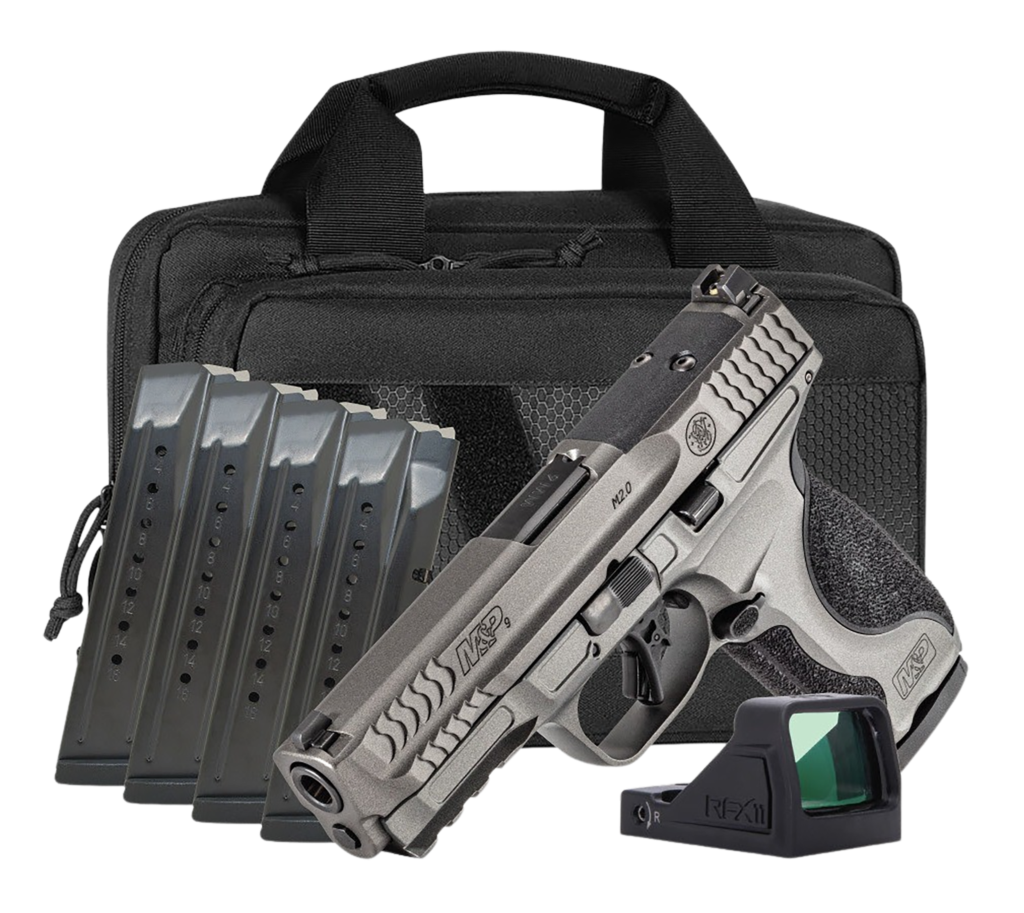
Smith & Wesson offers two distinct metal frame materials in this series. The standard M&P 2.0 Metal and Carry Comp models use an aluminum frame, keeping weight between 28 and 30 ounces, which is comparable to a loaded polymer duty pistol. The newer Metal HD variant uses a forged stainless steel frame that adds substantial heft, soaking up recoil energy that would otherwise transfer into the shooter’s hands. The functional benefits are immediate: reduced muzzle flip, faster follow-up shots, and a rigid platform that contributes to mechanical accuracy. The Metal HD also features distinctive cavities machined into the frame, a design choice that reduces weight while maintaining structural integrity. These cutouts serve a secondary purpose as well, providing a natural thumb rest for enhanced recoil management during rapid fire strings.
Complete Model Breakdown: Aluminum vs. Steel vs. Performance Center
The M&P 2.0 Metal lineup is broad enough to serve multiple shooting disciplines, but the core distinctions come down to frame material and factory tuning. Understanding these differences is essential before making a purchase decision.
Standard M&P9 M2.0 Metal (Aluminum Frame)
The aluminum-frame models represent the entry point into the Metal series, with an MSRP of $1049. Weight ranges from 28.1 to 30 ounces depending on barrel length, which is available in 4-inch, 4.25-inch, 4.6-inch, and 5-inch configurations. Standard capacity sits at 17 rounds, though compliant models with 10 or 15-round magazines exist for restricted states. This variant is best suited for shooters who want the metal-frame benefits, improved rigidity and reduced perceived recoil, without the weight penalty that makes all-day carry uncomfortable. The aluminum frame keeps the pistol balanced and familiar to anyone transitioning from a polymer M&P.
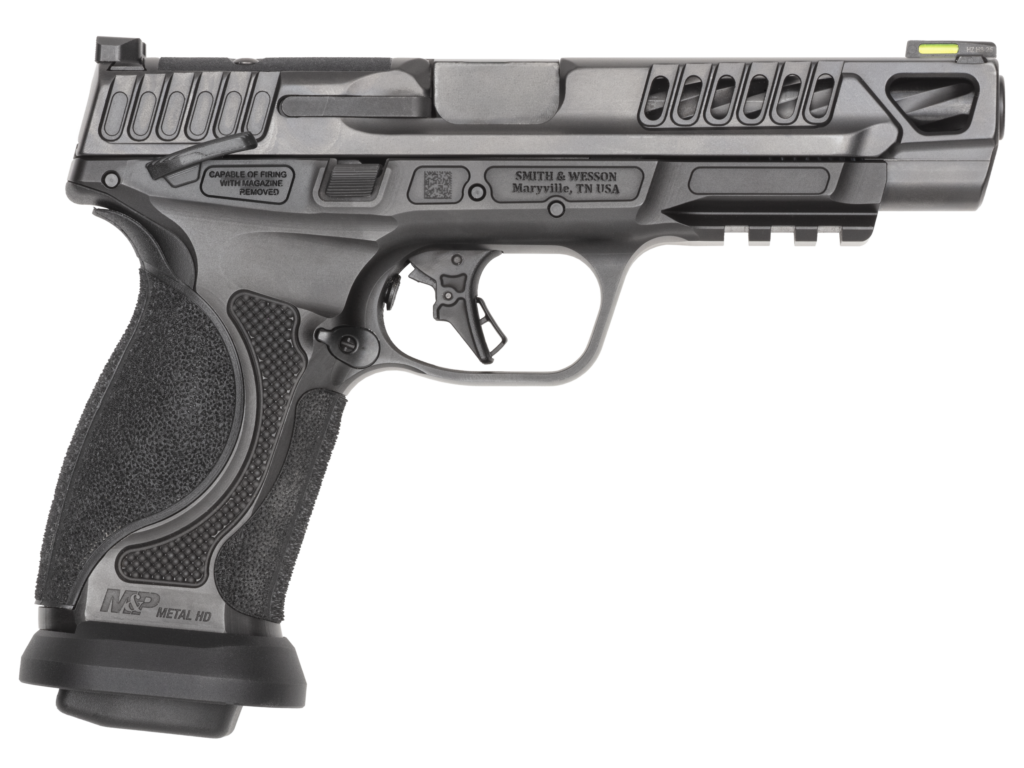
M&P9 M2.0 Metal HD (Forged Steel Frame)
The Metal HD is the flagship for recoil-sensitive shooters and competitors. Smith & Wesson has not published an official weight figure, but every review describes the pistol as substantial, with the heft concentrated in the grip for a low, planted feel during rapid fire. The cavity-machined frame is the visual signature of this model, and the grip texture is notably less aggressive than the standard polymer M&P 2.0, a detail confirmed by independent reviewers who found the polymer version’s texture abrasive during extended range sessions. The Metal HD prioritizes shootability above all else, making it the obvious choice for competition and high-round-count training days where recoil fatigue becomes a real factor.
Performance Center & Carry Comp Variants
The Performance Center lineup takes the aluminum frame and adds factory-tuned triggers, premium finishes, and in the case of the Carry Comp model, an integrated compensator system. The PowerPort gas diversion system works in tandem with the ClearSight cut, a design feature that redirects gasses away from the optic window to keep the lens clean during extended shooting. Premium finishes include Gold PVD at $1,199 MSRP, along with OD Green and Black Multicam limited editions. Smith & Wesson also sells standalone slide kits for $299 to $479, allowing owners of existing M&P 2.0 pistols to add a Carry Comp or optic-ready slide without purchasing a complete firearm. This modular approach is uncommon among major manufacturers and adds long-term flexibility for anyone already invested in the M&P ecosystem.
Specifications & Performance Data
Independent testing conducted in early 2026 provides concrete trigger pull data for the Metal series. Measured pull weights ranged from 3 pounds 6.5 ounces to 3 pounds 14.3 ounces, placing the factory trigger well above average for a production striker-fired pistol. This is not a tuned competition trigger, but it is clean and consistent enough that many buyers will see no immediate need for aftermarket upgrades.
Barrel length options span from 3.6 inches on compact models to 5 inches on long-slide variants, with intermediate lengths of 4, 4.22, 4.25, 4.625, 4.8, and 4.87 inches available across the full SKU range. The lineup is overwhelmingly chambered in 9mm, though two .40 S&W variants remain in the catalog for shooters who prefer the larger caliber. Optics-ready slides with the ClearSight cut are standard on most models, with suppressor-height sights included on select variants.
One gap that honest buyers should acknowledge is the absence of long-term reliability data specific to the Metal series. The M&P 2.0 platform as a whole has a strong reputation for durability, but no independent source has published high-round-count testing, failure rate analysis, or ammunition sensitivity results for the metal-framed models. The assumption of reliability is reasonable given Smith & Wesson’s track record, but it remains an assumption until verified by extended testing.
How the Metal 2.0 Compares to the Competition
The Metal 2.0 enters a market with established competitors, and its value depends heavily on what the buyer prioritizes. Against the Glock 17 and 19, the Smith & Wesson offers a lower bore axis and a demonstrably better factory trigger, but the Glock remains lighter, less expensive, and supported by a larger aftermarket. The weight difference is not trivial for anyone considering carry use.
When placed beside the Sig Sauer P320 AXG, which also uses a metal frame at a similar price point, the M&P holds an advantage in trigger pull weight, with the Sig’s factory trigger typically breaking around 4.5 pounds compared to the Metal 2.0’s sub-4-pound average. The Sig, however, benefits from a broader ecosystem of grip modules, holsters, and third-party parts. Against the CZ P-01 and SP-01, both proven in competition circles, the M&P counters with a modern optics-ready design and a more consistent trigger pull out of the box, though the CZ’s track record in USPSA and IDPA is far longer.
The Metal 2.0’s strongest competitive arguments are its factory trigger quality, the modular slide kit ecosystem that lets owners reconfigure their pistol without buying a second gun, and the 18-degree grip angle that many shooters find more natural than the steeper angles of competing designs.
Is the Metal 2.0 Right for Concealed Carry?
The weight question dominates any concealed carry discussion of the Metal series. Aluminum-frame models at 28 to 30 ounces are comparable to a loaded Glock 19, which millions of people carry daily without issue. Compact variants with 3.6-inch barrels and 15-round capacity exist for those who want a shorter slide and grip, but the frame weight remains the same, making these pistols heavier than polymer subcompacts like the Shield Plus or Sig P365 series.
Practical carry considerations extend beyond the numbers on a scale. Holster compatibility is strong, as the Metal 2.0 fits most holsters designed for the standard M&P 2.0, though the added weight demands a sturdy gun belt and a holster with proper retention. Printing potential is comparable to any double-stack pistol of similar dimensions. The aluminum models are viable for strong-side belt carry, particularly in cooler months when cover garments are standard. The steel HD model, however, is best reserved for range and competition use, as its weight makes all-day carry a genuine commitment that most will find impractical.
Pricing, Value, and Resale Considerations
New pricing for the Metal series spans from $899 for California-compliant models to $1,199 for the Performance Center with compensator. The base M&P9 M2.0 Metal sits at $949, placing it firmly in premium territory for a production pistol.
Used market data requires careful interpretation. Some online sources list used values as low as $225 to $445, but these figures almost certainly reflect confusion with older or lesser M&P models rather than actual Metal 2.0 resale prices. A used Metal 2.0 in good condition typically retains 60 to 70 percent of its MSRP, placing realistic used prices in the $550 to $700 range depending on variant and condition. The Reddit consensus that the Metal 2.0 is “a little pricey for a self defense gun” reflects a valid perspective, but the value proposition shifts when the buyer prioritizes trigger quality and recoil management over raw cost savings.
Smith & Wesson backs every Metal 2.0 with its Lifetime Service Policy, a warranty that covers the original owner for the life of the firearm. This is a meaningful value-add for anyone planning long-term ownership and high round counts.
Accessories, Aftermarket Support & Known Issues
The most distinctive accessory offering is Smith & Wesson’s slide kit ecosystem. Standalone Carry Comp and optic-ready slides, priced from $299 to $479, let owners convert an existing M&P 2.0 into a compensated or optics-ready configuration without the expense of a complete second pistol. This modularity is rare among major manufacturers and rewards brand loyalty in a practical way.
Magazine compatibility extends across the entire M&P 2.0 family, including the palmswell backstraps that allow shooters to adjust grip circumference. Holster compatibility is similarly broad, with most M&P 2.0 holsters accommodating the metal-framed variants, though confirming fitment with specific manufacturers is always prudent before purchasing.
Regarding known issues, the Metal series currently has no widely reported problems. The slide-stop issue occasionally associated with the Shield 2.0, where the slide fails to lock back after the last round, does not appear to affect the Metal 2.0 based on available reports. This conclusion is drawn from the absence of complaints rather than affirmative testing, so new buyers should still verify proper function during their initial range sessions.
State Compliance & Buying Guide
Smith & Wesson produces specific SKUs for restricted states including California, Colorado, Connecticut, Washington D.C., Delaware, Hawaii, Illinois, Massachusetts, Maryland, New Jersey, New York, Rhode Island, Vermont, and Washington. California-compliant models start at $899, reflecting magazine capacity restrictions and loaded chamber indicator requirements that affect pricing and features.
The most reliable method for verifying availability in a specific state is to use the compliance filter on Smith & Wesson’s official website before visiting a dealer. Not all variants are available in all jurisdictions, and assuming a particular model is compliant can lead to frustration at the point of sale.
Final Verdict: Should You Buy the Smith & Wesson Metal 2.0 in 2026?
The Metal 2.0 lineup serves three distinct buyer profiles, and the right choice depends entirely on intended use. Competition and range shooters who value recoil control and trigger quality above all else should look to the Metal HD or Performance Center Carry Comp models. Duty and home defense users will find the standard aluminum model strikes the best balance of weight, capacity, and proven M&P reliability. Concealed carriers considering the compact aluminum variant should be honest about the weight penalty compared to polymer alternatives, though the pistol remains viable with proper belt and holster support.
The Smith & Wesson Metal 2.0 Handgun is a premium choice that justifies its price through superior trigger quality, a modular slide ecosystem that extends the pistol’s useful life, and the tangible shooting benefits that only a metal frame can deliver. For the right shooter, the premium over polymer is money well spent.

Woox SH.FRN112.04 Bravado Handguard Big Boy 44 Mag/44 Spl/45 Colt
Woox SH.FRN112.04 Bravado Handguard Big Boy 44 Mag/44 Spl/45 Colt
Cobalt Kinetics CKPROURG108SBLK CK-Pro Urg Aluminum Black Cerakote Receiver
Cobalt Kinetics CKPROURG108SBLK CK-Pro Urg Aluminum Black Cerakote Receiver